Why Did It Take the Ratification of the 21st Amendment to Make Alcohol Legal Again
The Eighteenth Subpoena (Amendment XVIII) of the United states of america Constitution established the prohibition of alcohol in the U.s.a.. The subpoena was proposed by Congress on December 18, 1917, and was ratified past the requisite number of states on January xvi, 1919. The Eighteenth Subpoena was repealed by the Xx-first Amendment on December five, 1933. It is the only amendment to be repealed.
The Eighteenth Amendment was the product of decades of efforts by the temperance movement, which held that a ban on the auction of booze would ameliorate poverty and other societal issues. The Eighteenth Subpoena declared the production, transport, and sale of intoxicating liquors illegal, though it did not outlaw the actual consumption of alcohol. Shortly afterwards the subpoena was ratified, Congress passed the Volstead Act to provide for the federal enforcement of Prohibition. The Volstead Act declared that liquor, vino, and beer all qualified every bit intoxicating liquors and were therefore prohibited. Under the terms of the Eighteenth Amendment, Prohibition began on January 17, 1920, one year subsequently the amendment was ratified.
Although the Eighteenth Subpoena led to a decline in alcohol consumption in the United States, nationwide enforcement of Prohibition proved difficult, particularly in cities. Rum-running (bootlegging) and speakeasies became popular in many areas. Public sentiment began to plow against Prohibition during the 1920s, and 1932 Democratic presidential nominee Franklin D. Roosevelt called for its repeal. The Twenty-beginning Amendment finally did repeal the Eighteenth in 1933, making the Eighteenth Subpoena the but i so far to be repealed in its entirety.
Text [edit]
Section one. Afterwards 1 year from the ratification of this commodity the industry, auction, or transportation of intoxicating liquors within, the importation thereof into, or the exportation thereof from the United States and all the territory subject to the jurisdiction thereof for drink purposes is hereby prohibited.
Section 2. The Congress and the several States shall have concurrent power to enforce this commodity by appropriate legislation.
Section 3. This article shall be inoperative unless it shall have been ratified as an amendment to the Constitution by the legislatures of the several States, equally provided in the Constitution, inside 7 years from the date of the submission hereof to us by the Congress.
Background [edit]
The Eighteenth Subpoena was the result of decades of effort by the temperance movement in the United States and at the fourth dimension was generally considered a progressive amendment.[1] Starting in 1906, the Anti-Saloon League (ASL) began leading a campaign to ban the sale of alcohol at the land level. They led speeches, advertisements, and public demonstrations, claiming that banning the sale of alcohol would get rid of poverty and social issues, such as immoral behavior and violence. It would also inspire new forms of sociability between men and women and they believed that families would exist happier, fewer industrial mistakes would be made, and overall, the world would be a better identify.[2] Other groups, such every bit the Women'southward Christian Temperance Matrimony, also began trying to ban the sale, manufacture, and distribution of alcoholic beverages.[two] A well-known reformer during this time menses was Carrie Nation, whose violent actions—vandalizing saloon property—made her a household name across America.[3] Many country legislatures had already enacted statewide prohibition prior to the ratification of the Eighteenth Subpoena but did not ban the consumption of alcohol in most households. It took some states longer than others to ratify this amendment, especially northern states, including New York, New Jersey, and Vermont. They violated the constabulary by still allowing some wines and beers to exist sold.[2] By 1916, 23 of 48 states had already passed laws confronting saloons, some even banning the manufacture of booze in the get-go place.[three]
The Temperance Motion [edit]
The temperance movement was defended to the complete exclusion of alcohol from public life. The motility began in the early 1800s inside Christian churches, and was very religiously motivated. The central areas within which the group was founded included the Saratoga area of New York, as well as parts of Massachusetts. Churches were also highly influential in gaining new members and support, garnering vi,000 local societies in several different states.[4]
A grouping that was inspired by the motion was the Anti-Saloon League, which at the beginning of the 20th century began lobbying heavily for prohibition in the U.s.. The group was founded in 1893 in the state of Ohio, gaining massive support from evangelical Protestants, and becoming a national system in 1895. The grouping was successful in helping implement Prohibition, through heavy lobbying and having a vast influence. Post-obit the repeal of Prohibition, the group brutal out of power, and in 1950 it merged with other groups, forming the National Temperance League.[5]
Proposal and Ratification [edit]

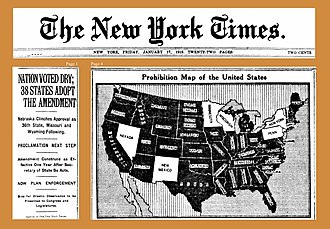
Later the 36th country adopted the subpoena on January xvi, 1919, the U.S. Secretary of Land had to issue a formal proclamation declaring its ratification.[six] Implementing and enforcement bills had to be presented to Congress and country legislatures, to be enacted earlier the amendment's effective date one year after.[6]
On Baronial 1, 1917, the Senate passed a resolution containing the language of the amendment to be presented to the states for ratification. The vote was 65 to 20, with the Democrats voting 36 in favor and 12 in opposition; and the Republicans voting 29 in favor and 8in opposition. The Business firm of Representatives passed a revised resolution[7] on December 17, 1917. This was the get-go amendment to impose a engagement by which information technology had to exist ratified or else the amendment would exist discarded.[eight]
In the Business firm, the vote was 282 to 128, with the Democrats voting 141 in favor and 64 in opposition; and the Republicans voting 137 in favor and 62 in opposition. Four Independents in the House voted in favor and ii Independents cast votes against the amendment.[9] It was officially proposed by the Congress to usa when the Senate passed the resolution, by a vote of 47 to eight, the next mean solar day, December 18.[10]
The amendment and its enabling legislation did not ban the consumption of alcohol, but made information technology hard to obtain alcoholic beverages legally, every bit information technology prohibited the sale, manufacture and distribution of them in U.S. territory. Any one who got caught selling, manufacturing or distributing alcoholic beverages would be arrested.[ii] Because prohibition was already implemented by many states, it was quickly ratified into a law.[viii] The ratification of the Subpoena was completed on January xvi, 1919, when Nebraska became the 36th of the 48 states then in the Spousal relationship to ratify it. On Jan 29, interim Secretarial assistant of Country Frank L. Polk certified the ratification.[11]
The following states ratified the amendment:[12]
- Mississippi: January 7, 1918
- Virginia: January 11, 1918
- Kentucky: January 14, 1918
- Northward Dakota: January 25, 1918)[note 1]
- South Carolina: January 29, 1918
- Maryland: February 13, 1918
- Montana: February xix, 1918
- Texas: March 4, 1918
- Delaware: March xviii, 1918
- S Dakota: March twenty, 1918
- Massachusetts: April ii, 1918
- Arizona: May 24, 1918
- Georgia: June 26, 1918
- Louisiana: August 3, 1918[notation 2]
- Florida: November 27, 1918
- Michigan: Jan two, 1919
- Ohio: January 7, 1919
- Oklahoma: Jan vii, 1919
- Idaho: January viii, 1919
- Maine: January viii, 1919
- West Virginia: Jan 9, 1919
- California: January thirteen, 1919
- Tennessee: January 13, 1919
- Washington: Jan xiii, 1919
- Arkansas: January 14, 1919
- Illinois: January fourteen, 1919
- Indiana: January 14, 1919
- Kansas: Jan 14, 1919
- Alabama: January 15, 1919
- Colorado: January xv, 1919
- Iowa: Jan 15, 1919
- New Hampshire: January 15, 1919
- Oregon: January 15, 1919
- North Carolina: January 16, 1919
- Utah: Jan 16, 1919
- Nebraska: January sixteen, 1919
- Missouri: January 16, 1919
- Wyoming: January 16, 1919
- Minnesota: January 17, 1919
- Wisconsin: January 17, 1919
- New United mexican states: Jan 20, 1919
- Nevada: January 21, 1919
- New York: January 29, 1919
- Vermont: Jan 29, 1919
- Pennsylvania: February 25, 1919
- New Jersey: March 9, 1922
2 states rejected the subpoena:
- Connecticut[13] [xiv]
- Rhode Island[thirteen] [15]

Prohibition agents destroying barrels of alcohol
To define the language used in the Amendment, Congress enacted enabling legislation chosen the National Prohibition Act, better known every bit the Volstead Act, on October 28, 1919. President Woodrow Wilson vetoed that bill, but the House of Representatives immediately voted to override the veto and the Senate voted similarly the next day. The Volstead Act gear up the starting date for nationwide prohibition for Jan 17, 1920, which was the primeval date allowed past the 18th amendment.[16]
The Volstead Act [edit]
This deed was conceived and introduced by Wayne Wheeler, a leader of the Anti-Saloon League, a group which found alcohol responsible for well-nigh all of society'south problems and which also ran many campaigns against the sale of alcohol.[17] The law was also heavily supported by and so-Judiciary Chairman Andrew Volstead from Minnesota, and was named in his honor. The human activity in its written form laid the groundwork of prohibition, defining the procedures for banning the distribution of alcohol including their production and distribution.[eighteen]
Volstead had one time earlier introduced an early on version of the police to Congress. It was first brought to the floor on May 27, 1919, where information technology met heavy resistance from Democratic senators. Instead, the so-called "moisture law" was introduced, an try to end the wartime prohibition laws put into effect much earlier. The debate over prohibition would rage for that entire session, as the House was divided among what would become known every bit the "os-drys" and the "wets". Because Republicans held the majority of the House of Representatives, the Volstead Act finally passed on July 22, 1919, with 287 in favor and 100 opposed.
However, the deed was largely a failure, proving unable to preclude mass distribution of alcoholic beverages and as well inadvertently causing a massive increase in organized crime.[nineteen] The human action would go on to define the terms and enforcement methods of prohibition, until the passing of the 21st amendment in 1933 effectively repealed it.
Controversies [edit]
The proposed amendment was the first to contain a provision setting a deadline for its ratification.[20] That clause of the amendment was challenged, with the case reaching the Us Supreme Court. It upheld the constitutionality of such a deadline in Dillon v. Gloss (1921). The Supreme Courtroom also upheld the ratification by the Ohio legislature in Hawke 5. Smith (1920), despite a petition requiring that the thing go to ballot.
This was not the just controversy effectually the amendment. The phrase "intoxicating liquor" would not logically have included beer and wine (equally they are not distilled), and their inclusion in the prohibition came every bit a surprise to the general public, too every bit wine and beer makers. This controversy acquired many Northern states to not abide by the subpoena, which caused some problems.[ii] The brewers were probably not the only Americans to be surprised at the severity of the authorities thus created. Voters who considered their own drinking habits blameless, but who supported prohibition to subject others, as well received a rude stupor. That daze came with the realization that federal prohibition went much farther in the direction of banning personal consumption than all local prohibition ordinances and many land prohibition statutes. National Prohibition turned out to be quite a different beast than its local and state cousins.
Under Prohibition, illegal importation and production of alcoholic beverages (rum-running, bootlegging) occurred on a large scale beyond the United States. In urban areas, where the majority of the population opposed Prohibition, enforcement was generally much weaker than in rural areas and smaller towns. Perhaps the most dramatic issue of Prohibition was the effect it had on organized crime in the United States: as the production and auction of alcohol went further cloak-and-dagger, it began to exist controlled by the Mafia and other gangs, who transformed themselves into sophisticated criminal enterprises that reaped huge profits from the illicit liquor merchandise.[ commendation needed ]
The Mafia became skilled at bribing police and politicians to "expect the other way" during the 1920s. Chicago's Al Capone emerged as the most notorious case of this phenomenon, earning an estimated $60one thousand thousand annually from his bootlegging and speakeasy operations. Gambling and prostitution also reached new heights, and a growing number of Americans came to arraign Prohibition—despite the legislation's original intent—and to condemn it every bit a unsafe infringement of individual freedom.[21]
Daniel Okrent identifies the powerful political coalition that worked successfully in the ii decades leading to ratification of the Eighteenth Subpoena. Five distinct, if occasionally overlapping, components made upwardly this unspoken coalition: racists, progressives, suffragists, populists (whose ranks included a small socialist auxiliary), and nativists.[ further explanation needed ] Adherents of each group may accept been opposed to alcohol for its own sake, but they advanced ideologies and causes that had little to do with it.[22] [ failed verification ]
Calls for repeal [edit]
If public sentiment had turned against Prohibition past the late 1920s, the Bully Low only hastened its demise, as some argued that the ban on booze denied jobs to the unemployed and much-needed revenue to the regime. The efforts of the nonpartisan Association Against the Prohibition Subpoena (AAPA) added to public disillusionment. In 1932, the platform of Democratic presidential candidate Franklin D. Roosevelt included a plank for repealing the 18th Subpoena, and his victory that November marked a sure stop to Prohibition.
In Feb 1933, Congress adopted a resolution proposing the Twenty-first Amendment, which repealed the 18th Amendment and modified the Volstead Act to let the sale of beer. The resolution required state conventions, rather than the state legislatures, to approve the amendment, effectively reducing the process to a one-state, one-vote plebiscite rather than a pop vote. A few states continued statewide prohibition later on 1933, but by 1966 they all had abandoned it.[21]
Impact [edit]
But afterward the Eighteenth Amendment'southward adoption, there was a significant reduction in booze consumption among the full general public and especially among low-income groups. There were fewer hospitalizations for alcoholism and likewise fewer liver-related medical problems. However, consumption soon climbed as underworld entrepreneurs began producing "rotgut" booze which was full of dangerous diseases.[3] [ failed verification ]. With the rise of home distilled alcohol, careless distilling led to the deaths of many citizens. During the ban upwards of 10,000 deaths can be attributed to wood alcohol (methanol) poisoning.[23] Ultimately, though, during Prohibition use and abuse of alcohol remained significantly lower than before it started.[24]
Though there were significant increases in crimes involved in the production and distribution of illegal alcohol, at that place was an initial reduction in overall crime, mainly in types of crimes associated with the furnishings of alcohol consumption such as public drunkenness.[25] Those who continued to use alcohol, tended to turn to organized criminal syndicates. Police enforcement wasn't strong enough to cease all liquor traffic; nonetheless, they used "sting" operations, such as Prohibition agent Eliot Ness famously using wiretapping to discern secret locations of breweries.[ii] The prisons became crowded which led to fewer arrests for the distribution of alcohol, also every bit those arrested being charged with small fines rather than prison fourth dimension.[2] The murder charge per unit fell for two years, but and then rose to record highs because this market became extremely attractive to criminal organizations, a trend that reversed the very twelvemonth prohibition ended.[25] The homicide charge per unit increased from half-dozen per 100,000 population in the pre-Prohibition period to nigh ten.[26] Overall, crime rose 24%, including increases in assault and battery, theft, and burglary.[27]
Anti-prohibition groups were formed and worked to take the Eighteenth Subpoena repealed, which was done by adoption of the Twenty-first Amendment on December 5, 1933.[28]
Bootlegging and Organized Criminal offence [edit]
Post-obit ratification in 1919, the subpoena's effects were long lasting, leading to increases in crime in many large cities in the United States, like Chicago, New York, and Los Angeles.[29] Along with this came many separate forms of illegal booze distribution. Examples of this include speakeasies and bootlegging, equally well as illegal distilling operations.
Bootlegging got its outset in towns bordering Mexico and Canada, as well as in areas with several ports and harbors, a favorite distribution area being Atlantic City, New Bailiwick of jersey. The booze was often supplied from diverse strange distributors, like Cuba and the Bahamas, or fifty-fifty Newfoundland and islands under rule past the French.
The government in response employed the Declension Guard to search and detain any ships transporting alcohol into the ports, only with this came several complications such as disputes over where jurisdiction lay on the water. This was what made Atlantic City such a hot spot for smuggling operations, because of a aircraft point nearly three miles off shore that U.Due south. officials could not investigate, further complicating enforcement of the amendment. What made matters even worse for the Coast Guard was that they were not well equipped enough to chase downwardly bootlegging vessels. The Coast Guard even so, was able to respond to these issues, and began searching vessels out at sea, instead of when they fabricated port, and upgraded their own vehicles assuasive for more than efficient and consistent arrests.
But fifty-fifty with those advancements in enforcing the amendment, there were even so complications that plagued the regime's efforts. One result came in the form of forged prescriptions for alcoholic beverages. Many forms of alcohol were beingness sold over the counter at the fourth dimension, under the guise of being for medical purposes. Just in truth, these beverages had falsified the bear witness that they were medically fit to be sold to consumers.
Bootlegging itself was the leading factor that developed the organized crime-rings in big cities, given that controlling and distributing liquor was very difficult. From that arose many profitable gangs that would command every aspect of the distribution process, whether it exist concealed brewing and storage, operating a speakeasy, or selling in restaurants and nightclubs run by a specific syndicate. With organized crime becoming a rising problem in the United States, command of specific territories was a fundamental objective among gangs, leading to many vehement confrontations; as a result, murder rates and burglaries heavily increased between 1920 and 1933.[29] Bootlegging was also found to be a gateway offense for many gangs, who would then aggrandize operations into crimes such every bit prostitution, gambling rackets, narcotics, loan-sharking, extortion and labor rackets, thus causing issues to persist long after the amendment was repealed.
See also [edit]
- Dry county
Notes [edit]
- ^ Effective Jan 28, 1918, the date on which the North Dakota ratification was approved by the state Governor.
- ^ Effective August nine, 1918, the engagement on which the Louisiana ratification was approved by the country Governor.
References [edit]
- ^ Hamm, Richard F. (1995). Shaping the Eighteenth Amendment: temperance reform, legal civilization, and the polity, 1880–1920. UNC Printing Books. p. 228. ISBN978-0-8078-4493-9. OCLC 246711905.
- ^ a b c d e f thousand "User account—Gilder Lehrman Institute of American History". Gilderlehrman.org. Archived from the original on December 1, 2017. Retrieved August iv, 2019.
- ^ a b c "18th and 21st Amendments—Facts & Summary—HISTORY.com". HISTORY.com.
- ^ "Temperance Movement". Britannica.com . Retrieved November 21, 2017.
- ^ "Anti-Saloon League". Britannica.com . Retrieved November 21, 2017.
- ^ a b "Nation Voted Dry out, 38 States Adopt the Subpoena / Prohibition Map of the United States". The New York Times. January 17, 1919. pp. 1, iv.
- ^ 40 Stat. 1050
- ^ a b "Understanding the 18th Amendment". Laws.com . Retrieved February 9, 2019.
- ^ David Pietrusza, 1920: The Year of Half-dozen Presidents (NY: Carroll & Graf, 2007), 160
- ^ "Prohibition wins in Senate, 47 to 8" (PDF). New York Times. Dec nineteen, 1917. p. 6.
- ^ 40 Stat. 1941
- ^ The dates of proposal, ratifications and certification come from The Constitution Of The U.s. Of America Analysis And Interpretation Analysis Of Cases Decided By The Supreme Courtroom Of The U.s.a. To July ane, 2014, Usa Senate doctor. no. 108-17, at 35 north.ten.
- ^ a b Cohn, Henry Southward.; Davis, Ethan (2009). "Stopping the Current of air that Blows and the Rivers that Run: Connecticut and Rhode Island Reject the Prohibition Subpoena". Quinnipiac Police force Review. 27: 327, 328.
[I]t took until 1922 for the twoscore-sixth land, New Jersey, to ratify, and Connecticut and Rhode Island would never practise and so.
– via HeinOnline (subscription required) - ^ New York Times: "Connecticut Balks at Prohibition", Feb 5, 1919, accessed July 27, 2011
- ^ New York Times: "Rhode Island Defeats Prohibition", March thirteen, 1918, accessed July 27, 2011
- ^ "Woodrow Wilson—U.S. Presidents—HISTORY.com". HISTORY.com.
- ^ Smentkowski, Brian P. (August 22, 2017). ""Eighteenth Subpoena."". Britannica.com . Retrieved August four, 2019.
- ^ "The Volstead Act". History, Art & Athenaeum, U.Due south. House of Representatives . Retrieved November 21, 2017.
- ^ "Congress enforces prohibition." History.com, A&Eastward Television set Networks, www.history.com/this-day-in-history/congress-enforces-prohibition.
- ^ [1] [ expressionless link ]
- ^ a b "18th and 21st Amendments—Facts & Summary—HISTORY.com". HISTORY.com . Retrieved November 20, 2017.
- ^ "The 18th Amendment of the U.S. Constitution". National Constitution Center—The 18th Subpoena of the U.S. Constitution . Retrieved Nov 20, 2017.
- ^ Rothman, Lily (January 14, 2015). "The History of Poisoned Alcohol Includes an Unlikely Culprit: The U.S. Government". Time . Retrieved January 11, 2018.
- ^ {{Cite web|url=https://www.nber.org/arrangement/files/working_papers/w3675/w3675.pdf
- ^ a b "Cato Institute Policy Analysis No. 157 : Alcohol Prohibition Was a Failure" (PDF). Object.cato.org . Retrieved August 4, 2019.
- ^ "Prohibition = Violence". Reason.com. January 29, 2003. Retrieved August 4, 2019.
- ^ Histeropedia—The Eighteenth Subpoena's Contribution to Increased Offense and Societal Disobedience in the 1920s (Fall 2012)
Rather than reducing the criminal offense rates within the United States, prohibition resulted in an increased crime rate of 24% including increased assault and bombardment past thirteen%, homicide rates by 12.vii%, and burglaries and theft by 9%. - ^ Roosevelt, Franklin (December 5, 1933),
- ^ a b "Prohibition and the Ascension of the American Gangster". Prologue.blogs.archives.gov. January 17, 2012. Retrieved August 4, 2019.
External links [edit]
- The Constitution Of The United States Of America: Assay And Interpretation: Analysis Of Cases Decided By The Supreme Court Of The United states To June 28, 2002, United States Senate medico. no. 108–17.
- CRS Annotated Constitution: 18th Amendment
rasmussencusufattion.blogspot.com
Source: https://en.wikipedia.org/wiki/Eighteenth_Amendment_to_the_United_States_Constitution
0 Response to "Why Did It Take the Ratification of the 21st Amendment to Make Alcohol Legal Again"
Postar um comentário