Describe How You Could Continue This Process to Obtain a More Accurate Approximation of the Area
We introduce the basic idea of using rectangles to approximate the area under a curve.
Rectangles and areas
We want to compute the area between the curve and the horizontal axis on the interval :
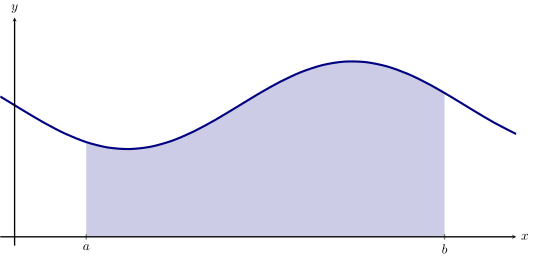
One way to do this would be to approximate the area with rectangles. With one rectangle we get a rough approximation:
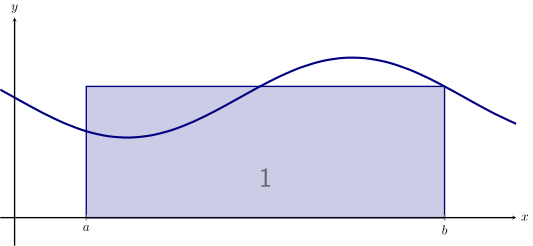
Two rectangles might make a better approximation:
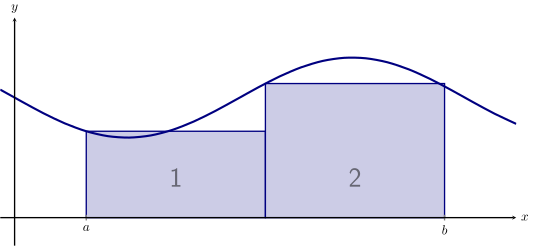
With even more, we get a closer, and closer, approximation:
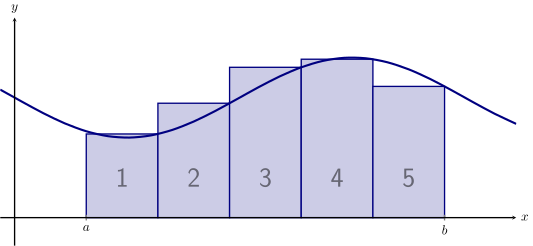
If we are approximating the area between a curve and the -axis on with rectangles of width , then
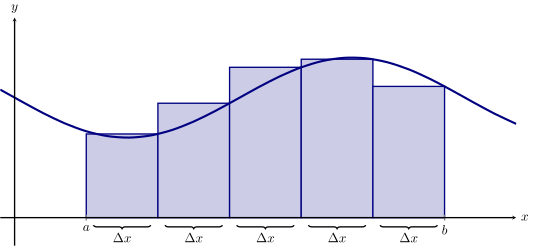
Suppose we wanted to approximate area between the curve and the -axis on the interval , with rectangles. What is ?
As we add rectangles, we are more closely approximating the area we are interested in:
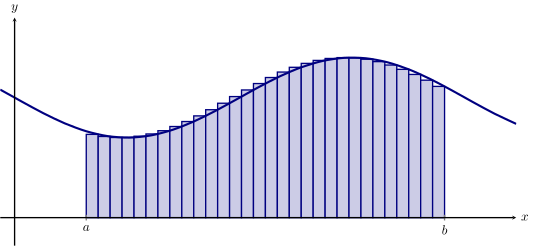
We could find the area exactly if we could compute the limit as the width of the rectangles goes to zero and the number of rectangles goes to infinity.
Let's setup some notation to help with these calculations:
When approximating an area with rectangles, the grid points are the -coordinates that determine the edges of the rectangles. In the graph below, we've numbered the rectangles to help you see the relation between the indices of the grid points and the th rectangle.
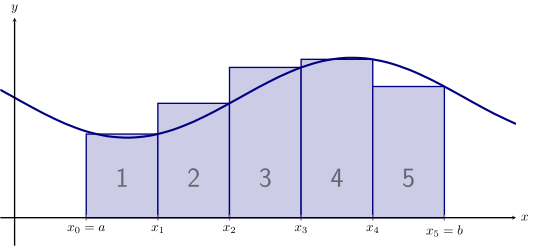
Note, if we are approximating the area between a curve and the horizontal axis on with rectangles, then it is always the case that
If we are approximating the area between a curve and the horizontal axis with rectangles, how many grid points will we have?
You can draw it!
We'll have grid points.
But which set of rectangles?
When we use rectangles to compute the area under a curve, the width of each rectangle is . It is clear that , for .
But how do we determine the height of the rectangle?
We choose a sample point and evaluate the function at that point. The value determines the height of a rectangle.
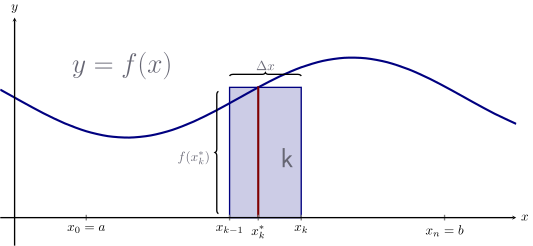
When approximating an area with rectangles, a sample point is the -coordinate that determines the height of rectangle. For , we denote a sample point as: and the value is the height of the rectangle.
What is the area of the rectangle shown in the figure above?
Here are three options for sample points that we consider:
Rectangles defined by left-endpoints
We can set the rectangles up so that the sample point is the left-endpoint.
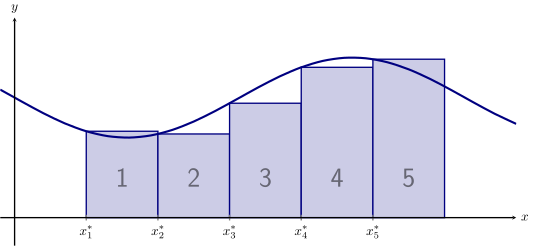
In the graph above, the rectangle's left-endpoint determines the height of the rectangle.
Rectangles defined by right-endpoints
We can set the rectangles up so that the right-endpoint determines the height.
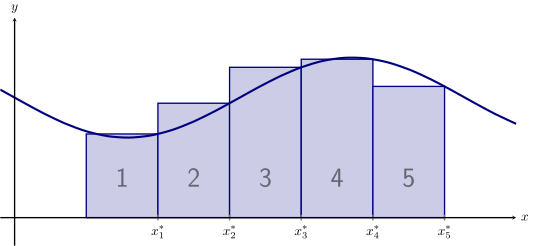
In the graph above, the rectangle's right-endpoint of the base determines the height.
Rectangles defined by midpoints
We can set the rectangles up so that the midpoint of the base determines the height.
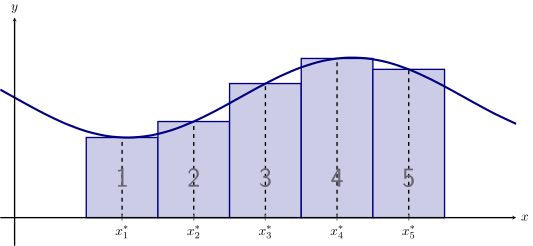
In the graph above, the midpoint of the base of the rectangle determines the height.
Riemann sums and approximating area
Once we know how to identify our rectangles, we can compute approximations of some areas. If we are approximating area with rectangles, then
A sum of the form: is called a Riemann sum, pronounced "ree-mahn" sum.
A Riemann sum computes an approximation of the area between a curve and the -axis on the interval . It can be defined in several different ways. In our class, it will be defined via left-endpoints, right-endpoints, or midpoints. Here we see the explicit connection between a Riemann sum defined by left-endpoints and the area between a curve and the -axis on the interval :
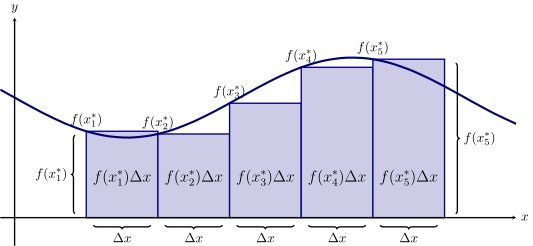
and here is the associated Riemann sum
Left Riemann sums
Consider . Approximate the area between the curve and the -axis on the interval using a left-endpoint Riemann sum with rectangles.
First note that the width of each rectangle is The grid points define the edges of the rectangle and are seen below:
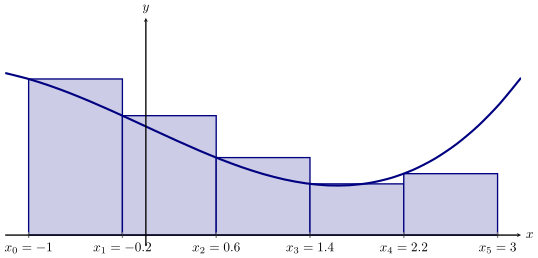
On the other hand, the sample points identify which endpoints we use:
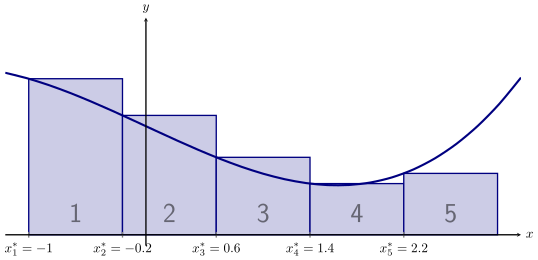
It is helpful to collect all of this data into a table: Now we may write a left Riemann sum which evaluates to and we find
Right Riemann sums
Consider . Approximate the area between the graph of and the -axis on the interval using a right-endpoint Riemann sum with rectangles.
First note that the width of each rectangle is The grid points define the edges of the rectangle and are seen below:
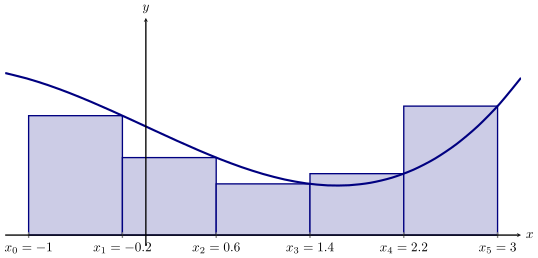
On the other hand, the sample points identify which endpoints we use:
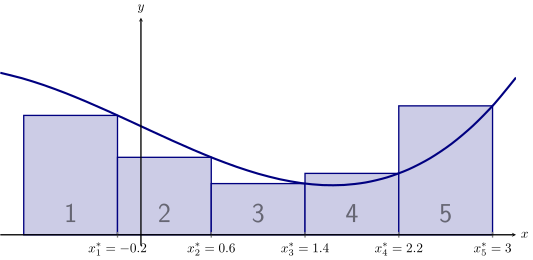
It is helpful to collect all of this data into a table: Now we may write a right Riemann sum which evaluates to and we find
Midpoint Riemann sums
Consider . Approximate the area between the graph of and the -axis on the interval using a midpoint Riemann sum with rectangles.
First note that the width of each rectangle is The grid points define the edges of the rectangle and are seen below:
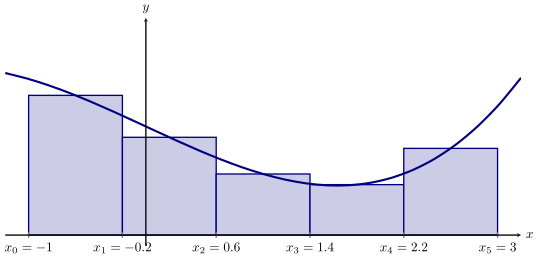
On the other hand, the sample points identify which endpoints we use:
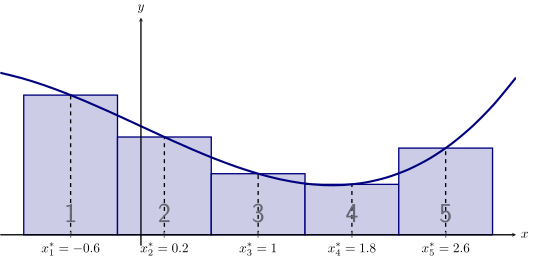
It is helpful to collect all of this data into a table: Now we may write a midpoint Riemann sum which evaluates to and we find
Consider the function on the interval . We will approximate the area between the graph of and the -axis on the interval . See the figure below.
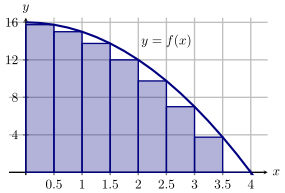
The image depicts a Left Right Midpoint Riemann sum with subintervals.
This approximation is an overestimate underestimate .
Consider the function on the interval . We will approximate the area between the graph of and the -axis on the interval using a right Riemann sum with rectangles. First, determine the width of each rectangle. Next, we will determine the grid-points.
For a right Riemann sum, for , we determine the sample points as follows: Now, we can approximate the area with a right Riemann sum. We can now simplify the last sum by using the distribution, commutativity and associativity properties of a sum. In the last sum, the constant is a common factor, so we can again apply the distribution property and obtain the following In the first sum above, the constant is added times, and we have a formula for the second sum. Recall: . Therefore, We can simplify this expression and obtain This approximation is an overestimate underestimate .
Now, we can take the limit of Riemann sums as to find the exact value of the area of the region under the curve on the interval . Namely, and, therefore
Summary
Riemann sums approximate the area between curves and the -axis via rectangles. When computing this area via rectangles, there are several things to know:
- What interval are we on? In our discussion above we call this .
- How many rectangles will be used? In our discussion above we called this .
- What is the width of each individual rectangle? In our discussion above we called this .
- What points will determine the height of the rectangle? In our discussion above we called these sample points, , and they can be left-endpoints, right-endpoints, or midpoints.
- What is the actual height of the rectangle? This will always be .
- We approximate the area with a Riemann sum
.
- As gets bigger and bigger, gets smaller and smaller, and approximation gets better and better. We compute the exact value of by taking the limit of Riemann sums
.
rasmussencusufattion.blogspot.com
Source: https://ximera.osu.edu/mooculus/calculus1/approximatingTheAreaUnderACurve/digInApproximatingAreaWithRectangles
0 Response to "Describe How You Could Continue This Process to Obtain a More Accurate Approximation of the Area"
Postar um comentário